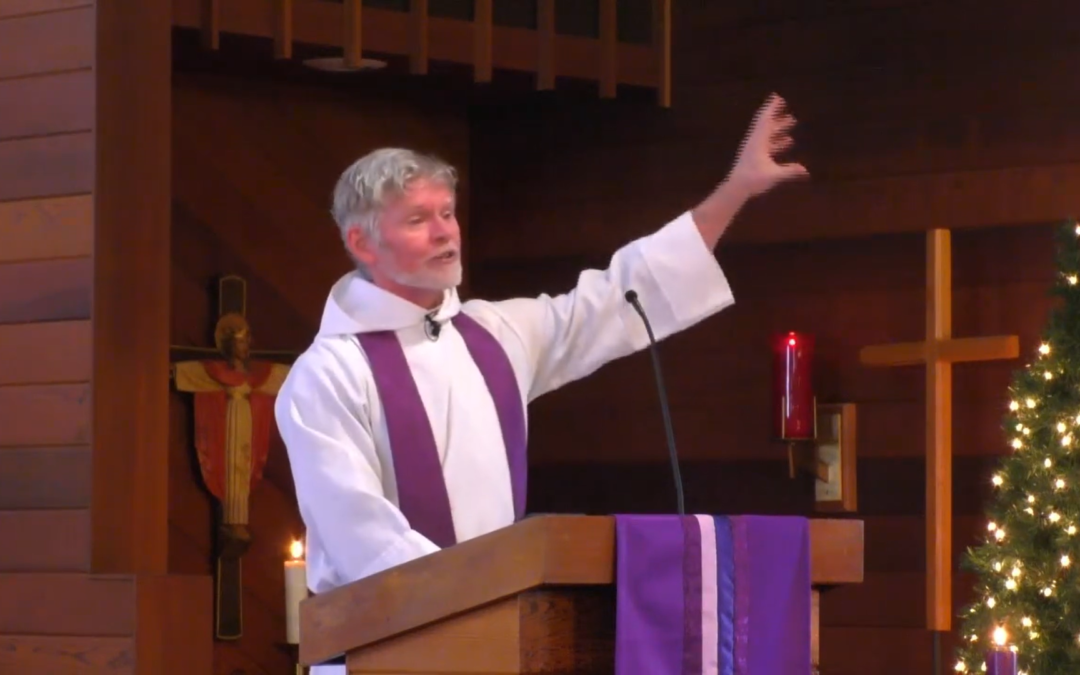

[Part Two] Full Transcript of Kendall Harmon’s Remarks to Vestry of Cathedral Church of the Advent
Special Thanks to StandFirm Commenters—KYounge1956, Underground Pewster, Martial Artist, GillianC—who nobly provided the transcription of a full hour and a half of Kendall Harmon’s words of wisdom and insight. Thank you so much!
Presentation by the Rev. Kendall Harmon to the Vestry and Staff of the Cathedral Church of the Advent, Birmingham, Alabama
This document was created by transcription from an audio recording. Speakers are indicated (where identifiable by the transcriber) by prefacing their remarks, thus: (Kendall) for Rev. Harmon, Dean Limehouse, Bishop Sloan.
Dean Limehouse: I’d just like to say that, in all my 15 years in this diocese, that I’ve never personally felt more optimistic about The Advent’s ministry within this diocese. I’ve spent some time with you Bp. Sloan, and while we may disagree on some of the issues of the church, I really sense that Kee has a respect for who the Advent is and what the Advent believes, and I also sense, and I really appreciate the fact that, as long as we don’t undermine his ministry that he is, with a very loving heart, wants to see the The Advent be The Advent, and I have some friends in conservative parishes in more what I would call “revisionist” dioceses, and they don’t have what I have. They feel persecuted, quite honestly and I’ve never felt that way. I feel more optimistic now than I have in seven years Kee, and I thank you for it.
I do want to say, while you’re here, that if at any point in time you would like to say something you’re more that welcome - you don’t have to say a thing, but just your presence means a lot.
Bishop Sloan: I didn’t know that I would have the opportunity to speak before I got here, and if I had known that I probably wouldn’t have come. [Laughter] I think that if we had the chance to sit down and have a cup of coffee or something more interesting, we would find several things that we disagree about. I don’t think we’d have to look long to find those things. I get the feeling that its the things we do agree about, that keep us in this church. I certainly agree with you that a lot of what you have said is a dismal report.
I think that the great gift we have is the love of God; that allows us to disagree a lot. I have been an Episcopalian for all my life; I’ve been a bishop for about four years, and I’ve been your diocesan for about a month and a half. I am well aware that there’s a lot that I don’t know, and I need to know a whole lot more about our Lord, about our faith, about The Advent, about the diocese, about the whole church. And I hope it is not simple or naive on my part to say that I am optimistic about the future of the Episcopal Church.
I know that doesn’t go very well with the dismal report. I’m not a player on the national level God forbid, but I love the Diocese of Alabama, and I love the work that we are able to do together. If you and I engaged in a debate, Dr. Harmon, I’m betting on you. (Laughter) I’ve never talked chapter and verse with a fundamentalist, and I’m not going to argue any of this with you, ‘cause I’ll lose.
I want to tell you, pardon me if I’ve told you this before, that it is our faith in God that will bring us through this. When I was a kid, my mom was a great cook. She’s still living, but she doesn’t cook anymore. When I was a kid, my dad was a great bartender, he’s gone, and one of his great gifts was that he could make an uncommonly good Old Fashioned. I don’t even know what is in an Old Fashioned, probably a good ...[inaudible].
Very often the priest and his wife, or the bishop and his wife would come to our house, mostly because mom was a good cook and partly because my dad made an uncommonly good …Old Fashioned and a good Bloody Mary too. And they would talk about the events of the day. They would talk about Bishop Pike. Remember Bishop Pike? He caused quite a stir, back in the early sixties, I guess. And they were convinced that this would be the ruin of the Episcopal Church… [inaudible]
They talked about General Convention giving money to the Black Panthers; oh, they were all upset about that. And way before all that died down they talked about revising the Prayer Book, and ordaining women. We didn’t even have girl acolytes in my parish, and now they’re talking about ordaining women to be priests? And each step of the way, they were just absolutely sure that this would be the ruin of us, we would not survive this.
I can’t really tell you how we did survive that except for our faith of God and the love of God among us. We’re not going to agree about everything, it is not in our personality to agree about everything. But we do need to claim the things that we have in common even with the people that we disagree with. I was glad to hear you say that some of these people who have very different ideas are not un-Christian, they’re not evil people, they’re not mean-spirited, they’re not faithless, they have a different idea, and sometimes a very different idea. And they could be wrong, but they’re not evil. They’re not faithless; they’re people with different ideas. And that’s part of our personality, is to share those different ideas. We can do that openly, honestly, lovingly, respectfully, and trust that the faith of God that has brought us this far will carry us on. So, I’m glad to be a part of the Episcopal church, I’m glad to be optimistic, and I’m glad for the life and work that we have together, and I’m glad that you’re here.
Unknown: Kendall, thank you so much Kee, how do you respond to Bishop Sloan there, we made it through a lot of crises, certainly the civil rights thing, with the segregation issue, with the Prayer Book revisions, with women’s ordination. What do you see different about this current issue that makes it different or can you comment on that?
Kendall: Yes, you sneaky guy you. But yes, in a number of ways. Let me just say this, sometimes people call it the third wave theology, but I think it is important to get at the assumptions underneath it. The Gospel engages the culture, the culture has its perspective, particularly among the elite, and the culture’s right and the church is wrong, and the church eventually gets its act together, right? So you have – so the simplistic way that third wave theology is presented is, we were wrong on the race issue, we got fixed, or at least we’re in the process of getting fixed, we got wrong on the women’s issue, we got fixed, now we’re on the same-sex union issue, and we are wrong and we’re gonna get fixed. So the culture’s always ahead and the church is as it were, always catching up, particularly the elite part of the culture. The difficulty with that is that you need to be careful to get at the assumptions that are in that so-called paradigm which are this:
—The church is sinful and inadequate
—Sometimes the church gets it wrong
—Sometimes the church needs to be corrected
All that is absolutely true. But the difficulty is this: the church, which is sinful and needs to be corrected, sometimes involves itself in the culture in such a way that it embraces stuff which isn’t Christian, and starts by embracing it and then actually later has to admit its mistake. You understand?
So sometimes the Church is right and the culture is wrong, and the culture actually has to learn from the church, and we could go through lots of examples. One of the ones that nobody notices in American history, which is crucial to me, is the whole area of eugenics. And the reason why it is crucial is that the Episcopal Church was up to its eyeballs in the eugenics movement. I don’t know how much you know about it but it’s the first fifty years of the twentieth century climaxing with an incredible Supreme Court decision called Buck vs. Bell where Oliver Wendell Holmes famously said, “Three generations of Bucks is enough.”
There was a woman who was going to have a child and she was involved in retardation and for the sake of the superiority of the species they decided that it wasn’t a good idea if she had children. “Three generations of Bucks is enough.”
Now that way of thinking, which has been completely discarded, was something that a number of leaders in the Episcopal Church got heavily involved in, and the Supreme Court got involved in it and all that has been reversed. So, the point is simply to say first of all it could work either way. It, in other words, doesn’t follow that it only moves in one direction, but the paradigm in the Episcopal Church is always presented in one direction, “We’re wrong, we catch up to the culture, the culture is right, we fix, we acknowledge our mistake.” That’s way over simplified.
The second thing to say in terms of what Bishop Sloan said, and again I certainly don’t disagree with what he said, that “we are here although we are more frail than we were”, but what I would say in response to that is, sociologically, there is a principle that sociologists use in the deterioration of a system called the Principle of Critical Mass. I don’t know how many of you are familiar with this concept, its very important, but what they show is that in a system that is about to collapse, the straw before the straw that broke the camel’s back is actually exactly the same size as the straw that breaks the camel’s back. And so, what you see in deteriorating systems is there is an assumption of health and a complete denial of the reality of deterioration, and since it hasn’t happened yet, therefore it won’t happen at all.
Now I’m not saying that the Episcopal Church is in the midst of imminent deterioration, that’s not what I believe. I believe we’re headed into being essentially a Unitarian universalist sect with a veneer of liturgical covering. That is essentially our future, and that has a very small niche market in American Christianity, although an ever shrinking one, but that is where we are headed as of now.
The reason I bring up the Principle is it doesn’t follow that since X and Y didn’t crash the system therefore Z won’t, because in deteriorating systems even if the straw is the same size, if the system is internally weaker, there comes a moment when collapse happens, and what is so scary is you do not know that when you are in the system at the time.
For those of you who know Russian history very well it is a great contemporary example. Hedrick Smith’s book “The Russians” in the nineteen seventies has a saying from the workers, “As long as they pretend to be paying us, we will pretend to be working”... [Laughter] ...one of my favorite parts of the book. But if you know the Soviet Union inside like Hedrick Smith did, (he was the New York Times Moscow correspondent for a long period of time) that whole system behind the Iron Curtain was collapsing years, years before the fall of the Berlin Wall, internally, and nobody was talking about it or even acknowledging the possibility of it, but when you have workers saying things like that in the seventies, you know that the system buy in is no longer there, and its only a matter of time. So that’s the kind of thing I’m talking about. It is something just to be aware of.
Question: I’ve got a lot of doctors from down at Providence here. We do believe that we don’t know where we will be this time next year, and we certainly don’t know what’s going to happen right after the aftermath of General Convention we don’t know where we will be from now five years from now, ten years or the next generation I’m a doctor down at Providence and we believe that what we would call by being a faithful remnant what others would call a stubborn remnant that God would bless our ministry and that we feel called to stay and to be that faithful.. I forgot how you termed it earlier…
Kendall: Faithfulness in little things is not a little thing.
Question continued: Yes, that’s pretty big. Other than that what can you say to encourage The Advent being a conservative parish in a denomination that is being revised and other that the fact that we have a bishop that respects what we are doing, and I believe he does indeed believe that Advent has a place in this diocese and I have not only been told that but I actually feel that. What else can you say to further this?
Kendall: This is sort of a harder question because it involves some risk, but what I would say is that what you need to realize is the relative oasis you have here is a position of strength from which you can go out and minister to others. That one of the huge tragedies, and I just want to speak about conservatives for a second, is that these clergy and others who are lost like deer in the headlights, they don’t have any support. You cannot imagine what the Advent can do for someone like that in all sorts of very distinctive local ways. And I want to put flesh on it if it is okay with you.
I mean just to give you an example, I said this to one of the parishes in our diocese and they adopted a priest and his family from Massachusetts, in a very dark situation they felt, and that relationship was a huge source of encouragement in both directions. Because one of the things that happened is they were informed about parts of the Episcopal Church they didn’t really know a lot about. And there was a lot of pain and a lot of doctrinal innovation that they weren’t aware of, but the flip side is they were able to really help somebody in need.
You see, the thing you need to keep in mind is structurally I am in the most stable position because I am in relatively speaking stable diocese, you are in a stable parish but what you need to realize that in many situations people don’t even have that, and this parish is in a position of strength to seek to creatively minister to people like that. You could have a conference and invite people to come to be encouraged specifically for that purpose, but when I say that I mean have them in your home for two days and minister to their families and to their marriages. That’s an example. There is very little what I like to call structural relief and I think one of the interesting things to think about at The Advent if I were here it would be what are the ways structurally that we can help relieve some of the suffering that some of the people who are trying to be traditional Gospel people in the Episcopal Church are going through because the loneliness and the isolation and the pressure that some feel is almost unimaginable to most of us and you can be very very helpful to them. Correspondence, those who love Skype or know Skype, you can have a face to face conversation with somebody on the other side of the country now, you don’t even have to pick up a plane fare. So there’s a lot of technological ways that you can be very creative. That would be an example of the kind of stuff that…
Comment: I think that we saw that a little bit at the Diocesan Convention Frank Smally, you, and Andrew and Joe Gibbs were at the table there where they were tabled with another parish that has an average Sunday attendance of thirty, and they said to us that they respected The Advent and that they were thankful for our ministry and they told a little bit about the problems they were having with having clergy there so that the Eucharist and priests coming in… various priests coming in. One of our guys said, I think it was Craig said well maybe we could help you out. Would you like us to come in and preach on some Sundays for you. I thought our eyes were going to well up cause he said would you do that for us?
Kendall: Let me tell you another quick story, one of my favorite stories that happened to me in the last ten years. I was once doing a vestry lunch after visiting a parish in the Diocese of Texas, and one of the lay women who was pretty spunky and I was tired and fried at lunch and kinda out of gas and so I didn’t care what I said and she said that “We can’t do anything” and I looked at her and I can’t really believe I did this but I said, “On the contrary, you can do nearly everything, and instead of running away from me, she ran toward me, and she said, “Really, What?” and I gave a list of about ten things I felt they could do, and can you believe in this, she came up with a ministry where their vestry goes to other parishes and shares with other vestries what’s going on and how to respond, seeking to be faithful all over the diocese, but she said “we can’t do anything.” What I said was, “You may seem little but you’d be surprised.” They are doing a lot, but it is contextual.
Dean Limehouse: We have about twenty minutes… I would like to open it up for anyone who that would like to have a question for Dr. Harmon or Bishop Sloan.
Question: The reason I quit reading most of the traditionalists, if I may use the term, sources on the internet for instance is they seem so doggone self-righteous, and even though I have no question that what the direction the Episcopal Church is taking is self destructive, and is false doctrine, at the same time we never look at our own selves. And it seems to me instead of feeling hatred for people like our Presiding Bishop we ought to be praying and praying and praying for her and ourselves, and if there is nothing else we can do, the most important thing we can do is pray.
Kendall: I’m actually glad you said that because this brings out one of my points that I haven’t made yet that I want to make sure to make, and I get in a lot of trouble but it doesn’t bother me cause as you can probably tell I have a high truth quotient. Conservatives are my biggest problem personally. I have been caused more pain by fellow conservatives than the rest of the Episcopal Church put together times five. That’s point one.
Point two is, and this is very important, in Israel when there is judgment and exile, all of Israel is under judgment, and one of the things I said at Plano the very first time and have been saying since, in spite of the fact to my frustration it’s not been sufficiently noticed is, we are responsible for what has happened and we are also under judgment The incredible trap of a situation like this is that “if they just hadn’t done this we’d be fine,” so that it is all “out there,” and it makes me weep the degree that conservatives contributed to this and had stuff that the Lord was after that we need to answer for at the time and through the time up to now and now is enormous and you spoke to that.
Here is one of the interesting things about what’s going on right now. The leadership of the Episcopal Church is almost impervious in terms of its own self criticism. If you read most episcopal publications and certainly the national publications there not only is nothing wrong, there’s no questions about anything that’s happening.
Here’s the incredible thing in the community of those who have left, many of whom are my friends, there’s no self criticism. What is scarier than I can possibly tell you is the degree to which my friends who have left have all sorts of resemblances to the community they departed from, and one of the biggest is a lack of self criticism. Which if you have a doctrine of Sin that is any good, ought to be… I mean the right way to respond as a sinner if somebody criticizes you is you assume they are right unless proven otherwise not the other way around. Now that is hard as prideful people, but you understand my point. So I just wanted to reinforce what you said, and I’m sorry about those conservative sites. I try hard to emphasize a balanced tone, but it is one of the ways that people cope with grief. I don’t say that to excuse it. I say it to describe it.
Question: I would like to ask a question. What do you think will come out of General Convention this summer that will impact The Advent? What type of things should we be getting ready for…
Kendall: I will say this to you, my mother, who is now gone from this world to the next I’m sorry to say, was a political science major from Duke so I was raised in a home where you learned in the area of trying to work with politics to always speak tentatively. As a young boy I had “Dewey beats Truman” beat into my head. So its very important, I answer this question tentatively based on what I now see. It will not be what I said two months ago, and it probably will not be what I say next month because the situation on the ground is constantly changing. In the Episcopal Church, if you stand still you are moving. You may not think that but you are. Its a moving situation so I speak tentatively.
I would say this, I think THE debate in the Episcopal Church right now is between two groups of people. I don’t like the language of liberal and conservative, I prefer reappraiser and reasserter, but the reappraisers, other people call them liberals, I prefer the term reappraisers—the people who are the majority party in the power structure of the Episcopal Church. There are two groups in that group of people. One is what I would call those of a more ideological bent and the other is those of a more of an institutional bent and of course they are both important because if you are interested in change, you have to have an institution through which you can get change to happen. If you blow the institution up in the process of change, then you have lost your change agent for the future, and over the last twelve to fifteen years, the only national debate that has mattered is between the ideological reappraisers or liberals and the more institutional liberals, and that is still the case.
But what you now have is, because of the situation in our culture, with more and more local state supreme courts deciding in favor of at least heading toward a greater legitimacy to same sex unions, say for example the recent decision of the legislature in the state of Washington just to name the most recent, but you know what I’m talking about… Vermont, and we could go on…, because of that and because of the conservatives departing have taken away basically an opposition that raised questions. I mean there is essentially no questioning anymore of the trajectory that they are on.
The only question is, “How fast will it go,” and I think that is the question going into this General Convention. You could state it this simply, How much will the embrace of the liturgical logic of the new sexual theology come to at a vote at this General Convention. That is the sixty four thousand dollar specific question.
So to make it even more specific, they are going to do either one of three things: one is they are going to very quietly move the embrace of same sex unions and its legitimacy forward in the Episcopal Church. I call it incrementalism. They’ve been doing this for years. You know, move the ball further down the field while not looking like they are really doing that, that’s in fact what they are going to be doing. If that happens that would be a win for the institutional reappraisers over the ideological reappraisers because you need a stable institution. You do it gradually to keep the institution together.
The second thing which I think is the more likely from where I sit is, and I would be interested to hear the Bishop’s take on this, is that I think you may see the embrace of an alternate liturgy for same sex unions in something like “The Book of Occasional Services” if, and this will be carefully done, IF, and this will be carefully done, IF a Diocese, in its own conscience, decides that’s what they want to do. So you understand, a more legitimated local option, where you actually admit what’s already going on all over the country anyway, but you just give it more legitimacy by having an official liturgy.
Right now, there are liturgies all over the country, but one of the crazy things is, they’re all different. There’s no common liturgy, because Vermont’s doing one thing, and some of the other Dioceses, like Chicago, are doing another thing. So there is a case to be made to at least try to get it more coherent, and at least have all the people that want to do this to do it in a basically similar direction that, one hopes, has some theological thought underneath it.
The last, which would be the most (I think) dramatic, would be what the Bishop of Olympia said on his blog recently, and I actually cited this on my own blog. He said, this is his prediction not mine, I think as of now, that he’s not correct, but part of the reason I quote it is he’s one of the leading re-appraisers in the House of Bishops. He says, he thinks they are going to approve same sex marriage at this General Convention. The incredible thing is, they easily have the votes to do that, but the institutional liberals are smart enough to know that you can only do so much. Because you need money, and you need people, and you need energy, and if you go too far, and you lose…. I mean, if you lead, and you’ve got very few followers, that’s not effective leadership.
So those are the three things that are going to get the most headlines. The first is not really going to be noticed at all, very little, and will seem like not much. If I were at The Advent I would say pay attention, it matters. Moving the ball further down the field is still moving the ball further down the field. The second would be more explicit, and I think that would raise more need, if I were here, to differentiate from that. To say more explicitly “We believe that this not is a legitimate Christian development, it’s something that not only we believe we will not embrace, but we will not in any way allow people to embrace it without explicitly saying again and again ‘We believe it’s wrong’”.
See, that’s the hard thing about this situation. This is like a woman whose husband has had an emotional affair, but not yet consummated it, and they’re still in the relationship, and what she’s got to do is continue to say “What you are doing is wrong”. But after a while that gets old, and it’s easier at an emotional level to become a co-dependent, right? “I’m not going to say anything any more”. But if you do that, you are somehow tacitly saying it’s OK.
One of the hardest things for the conservatives that are still in the Episcopal Church right now, is to find creative but nevertheless faithful ways to say “Look, this isn’t right” and to say it in a Christian way. It’s not easy to do.
The third would be, I think, a more dramatic development. I don’t think, as of now, that that’s likely. It’s possible. It certainly depends…one of the things, I know the bishop will agree with me on this, when you go to General Convention, you never know what’s going to happen until you actually get there. They can take enormous individual personalities and routes that you can’t possibly tell until you’ve been there a couple days. It takes on its own corporate personality. It’s a huge meeting, huge number of people, one of the largest meetings of its kind in the world, still. It’s crazy, we ask lay people to take two weeks off of work to go do this.
For those of you who know John Claypool, he had a woman who was a banker in his parish when he was here, and her boss came to her after she did two General Conventions and said “you either stop doing this or I’m going to have to fire you”. Because she kept taking two weeks off from work once every three years and then when she came back she wasn’t the same for two weeks, to sort of regroup and do re-entry shock and re-acclimatization. It’s an enormously significant meeting with enormous implications and costs to those who are there, so…. Does that get at…
Question: Just a quick question, when you were going through those three scenarios a second ago, the first two you said “same sex union” and the third one you said “same sex marriage”...
Kendall: Right, that’s the language the Bishop of Olympia used, it’s not the language that I would use, and I think I would be very surprised if they pull that off, precisely because of that change in language. That’s one of the many problems with what’s happening in America right now is, in spite of all the pleas, the brutal reality is, marriage has a definition, and no matter what my sense of your individual rights are, I can’t give you something by changing what it is, and then giving it to you, because then I’m not giving you what you want, I’m giving you something else. And one of the weirdest things that’s going on is, we’re changing the fundamental definition of a very cherished institution without engaging in all the implications that are involved in that.
I think a number of the more thoughtful people in leadership in the Episcopal Church are aware of that, and that is a bridge too far. But that’s what he says on his blog, and he may be right. That’s certainly the direction that some, like Vermont—they are using that language, some of the more bold individual states are using that language.
Question: Kendall, could you clarify the practical implications of that second option, the Book of Occasional Services.
Kendall: Right…
Question: That would be, like, alongside blessing a home.
Kendall: Right, and it would…
Question: What you’re talking about is a canonical change of the actual Prayer Book service…
Kendall: Well, that’s the difficulty with what the Bishop of Olympia is saying, is you have to sort of tease out what’s involved, and if you do it aboveboard and honestly, that’s one of the things that you need to do. You actually need to change some very specific canonical language and some very major doctrinal things to get it right. And you cannot just do that at one General Convention, I don’t think. But far be it from me to predict in absolute terms what’s going to happen. But that’s what I meant.
Question: Could I ask the bishop to comment on the same question.
Kendall: Yes, that’d be good.
Bishop Sloan: Yes, you may. (laughter)
Comment: So moved.
Bishop Sloan: Thank you. Greg Rickel is the Bishop of Olympia, a nice guy. He’s in my class. All Bishops are arranged by what year they were consecrated. Mark Lawrence, is the Bishop of South Carolina, a nice guy, he’s also in my class. So we have a lot of diversity among the people in the House of Bishops that I know the best.
“Dewey Defeats Truman.” I’ve been to all of one General Convention, and it was an amazing and bewildering thing. In 2003, I was Rector of St. Thomas in Huntsville. I with great confidence assured the people that we would never vote for…to consent to the election of Gene Robinson as Bishop of New Hampshire. I was kind of concerned about the House of Deputies, because they’re a little…umm…”over there”, but I was convinced the House of Bishops would never let that happen. So I’m pretty clear in my own mind that I’m not a good predictor of what might happen.
The language that’s been used and brought forth by the Standing Committee on Liturgy and Music asks for authorization for services to be used in trial usage to bless same gender unions. That committee very carefully and very clearly stayed away from referring to this as marriage. This is not a sacramental rite, according to what’s being presented from the Standing Commission on Liturgy and Music, but more like the blessing of a home, more like the blessing of other things. It would not…their recommendation is that this not be in the Book of Occasional Services, and not in the Prayer Book, but in a separate volume published by itself, “Liturgical Resources”.
The Standing Committee on Liturgy and Music was asked by the previous General Convention to come up with theological and pastoral resources and liturgical resources to further the conversation in General Convention, which they have done and that’s the resolution that they’ll be called upon [inaudible].
I like Greg Rickel, the Bishop of Olympia. He’s wrong—I hope—that he’s wrong. My past history in predicting what General Convention might do is a little spotty, but surely, surely we won’t do that, so that we are referring to this as a marriage.
Kendall: I would just add this clarifying comment about that, and that is that what was just described, in my view, what the SCLM is proposing, which is the Standing Commission on Liturgy and Music—they’re one of the standing commissions during the three years between General Conventions that has certain official responsibilities, they’re responsible for liturgy. I would consider that the incremental step, that I was speaking about, because notice it was said, it’s not in the Book of Occasional Services. So it has a quasi-official status in local practice, but it has no official status, even in optional official liturgy, so there’s a subtle difference between those two. And I think it’s between those two that the interesting debate I think will come.
Question: If a same-sex couple went to the courthouse and married, and then came to the church to ask for a blessing, are you not in essence blessing that marriage?
Kendall: Did everybody hear the question? It’s a very good question. It’s one of the reasons why what’s happening is happening, at the last General Convention, one of the things that came up in the House of Bishops was “hey look, in our state, I mean Vermont is a good example, this is one of the things people are coming to us and asking for, so it seems odd”. The short answer to your very good question is, it depends on what the person involved in the pastoral situation actually chooses to do. A number of them are doing that locally in their own parish. That’s not my understanding with what the majority think that they’re doing right now. I think that the majority who are doing it are doing it—they are making this distinction between union and marriage that you just heard. So I would say, in the majority of cases—not every case—they would consider themselves praying for the blessing on the union, and therefore they would say it is a blessing on the union, not on a marriage. But again, it starts to look more official, and then it looks even more official if you have some kind of liturgy and some kind of event where people are involved, and that’s happening all over.
Dean Limehouse: Kendall, I want to thank you for being with us. Thank you guys for coming out. Bishop Sloan, God bless you my friend and thank you for coming.
I guess my parting words would be, if God is not in control, start worrying. Again, we just lift up that high doctrine of God’s providence one more time.
Thank you for that wonderful reading in Second Chronicles I think it is, the Lord says “this battle is not yours it’s mine; Stand firm, and see the victory of the lord”. I just promise you guys, that The Advent’s going to stand firm, whatever happens, we’ll stand firm. Again being redundant, thank God for Bishop Sloan’s willingness to accept The Advent for who The Advent is.
Let’s go forth into the world, rejoicing in the power of the Spirit.
All: Thanks be to God.
Share this story:
Recent Related Posts
- California Court of Appeal Denies ECUSA’s Writ Petition
- No News from Texas; Sad News from Virginia
- Another California Judge Denies Summary Relief to ECUSA (Updated)
- You win or you die
- Shiny Red Balls & Red Herrings in Upper South Carolina: Three Notes on Bishop Waldo’s Clergy Email
- Waldo To Approve Same Sex Blessings: Truth & Consequences in the Diocese of Upper South Carolina
- Federal Judge Returns South Carolina Case to State Court

Comments
Facebook comments are closed.
1 comment
Dean Limehouse has not been in the Diocese of Alabama for 15 years, but for 7.
[1] Posted by heart on 3-19-2012 at 09:12 PM · [top]
Registered members are welcome to leave comments. Log in here, or register here.
Comment Policy: We pride ourselves on having some of the most open, honest debate anywhere. However, we do have a few rules that we enforce strictly. They are: No over-the-top profanity, no racial or ethnic slurs, and no threats real or implied of physical violence. Please see this post for more explanation, and the posts here, here, and here for advice on becoming a valued commenter as opposed to an ex-commenter. Although we rarely do so, we reserve the right to remove or edit comments, as well as suspend users' accounts, solely at the discretion of site administrators. Since we try to err on the side of open debate, you may sometimes see comments which you believe strain the boundaries of our rules. Comments are the opinions of visitors, and do not necessarily reflect the opinion of Stand Firm site administrators or Gri5th Media, LLC.